Thursday, April 22, 2010

Jungle Fever

They say there is a first for everything, and I have experienced my fair share of “firsts” this month. Just a few of these include handling a live anaconda, going for a night-time crocodile hunt and boating up the Amazon River in a canoe. The last on this list ended up being the worst, albeit most memorable, experience of my life. But I’ll get to that in a bit. Let’s begin from the beginning, shall we? For those of you not living in Peru, it might have slipped past you that the first week of April was Semana Santa, or Holy Week to my non-Spanish-speaking friends. The Peace Corps was gracious enough to give us hard-working Volunteers a few days off, so we took advantage of the rare opportunity and ventured out to see the Peruvian jungle. Here’s an interesting statistic taken directly from my Lonely Planet for your educational pleasure: roughly 50% of this country is covered by jungle, yet only about 5% of its population lives there. After this trip, I’m surprised it can manage to hold onto such a high percentage. Don’t get me wrong, it was everything I imagined and more… it’s just that jungle life is intense. Getting around this region makes transportation in the rest of the country look more efficient than a German train system. Example of a "taxi" we took numerous times... and got stuck in the mud several times:


I guess it doesn’t help that we chose the city of Iquitos for our final destination on this trip. Iquitos is famous for being the largest city in the world that you cannot reach by land. The result was a whole lotta boat travel. Our planned itinerary went something like this:

  • Bus from sites to meeting point in the city of Chiclayo (5.5 hours for me)
  • Bus from Chiclayo to city of Tarapoto (16 hours, over ROUGH terrain: several moments I found myself airborne)
  • Car from Tarapoto to town of Yurimaguas (3 hours, lots of hairpin curves)
  • Boat from Yurimaguas to town of Lagunas (10 hours)
  • Three-day canoe trip from Lagunas through a natural preserve, returning to Lagunas
  • Boat from Lagunas to Iquitos (32 hours)
  • Fly from Iquitos to Lima (1.5 hours… this was hard to believe after the week it took to actually arrive in Iquitos)
  • Bus from Lima to sites (16 hours for me)

Sounds like a good chunk of travel, no? Well, just hold on to your britches, because it gets better. The 32-hour boat ride to Iquitos was supposed to be on a large vessel, where we could hang up our hammocks, walk around, use the bathroom, etc. Not too bad. Unfortunately for us, this particular boat couldn’t leave due to “excess rains.” Apparently the mighty Amazon River couldn’t handle a little excess water. Seriously. So we were all stuck in the town of Lagunas an extra night, which was one night too many. The only decent hostel in town was full, so we ended up in the most horrid place I have ever seen. Trust me, that is saying a lot for a Peace Corps Volunteer and former backpacker. After being eaten alive by mosquitoes and other less-expected creatures in our room, we awoke to the news that the boat would not be leaving again the following day. It is difficult for me to explain how little the town of Lagunas has to offer, but let me just say that the extent of its “entertainment” that we found was eating canned-cheese and stale crackers in a hardware store. I could just envision myself being stuck in that remote and insignificant jungle town, being adopted by natives and eating grubs for the rest of my life. Any alternative was better than spending another night there. Alas, the list of alternatives was limited to one option: we could hire a couple of locals to take us in a smaller boat. It would cost us some serious soles, but it would only take 8 hours. Or so they said. When we arrived at the dock, we saw a small boat that seemed barely large enough to contain all of us (14 Volunteers in total and 3 locals). There was no bathroom. They didn’t answer when we asked if we could hang up all of our hammocks on this boat. In hind-site, this question must have seemed rather hilarious to our local drivers. We could not understand why they chuckled until a canoe, roughly 1/10 the size of that boat pulled up. Each of us watched incredulously as the men took the motor off of the small boat and attached it to the back of the much-smaller canoe. Clearly they don’t plan on piling all of us in that thing for eight hours, right? Oh Peru, you never fail to shock me.

Lovely town of Lagunas... it was hard to leave her behind!

The boat we thought we'd be taking... and the tiny canoe to the right of it

As the town of Lagunas waved from the shore, our little troupe of 17 took off to tackle the vast Amazon… in our canoe. All was going well until about the 5-hour mark. Somebody asked the driver how much further we had to go. The response was, “in an hour, we will be 8 hours away.” Excuse me? I thought we were 8 hours away 5 hours ago?? Yes, there was a “slight miscalculation.” Well there’s an understatement for you. So this meant that our 8 miserable hours on the canoe would turn into 14 miserable hours. We might have actually reached that goal, if not for the fact that our driver got lost somewhere in the middle of nowhere for about 4 hours. You do the math. 18 hours, 17 people, 1 canoe. Now add to the equation heavy rain with only a mildewed tarp for protection, a temperature drop of 30 degrees from day to night (and no way get to any extra clothes in our bags) and no padding between the hard planks and our battered bodies. Tons-o-fun! Needless to say, we all reached our breaking points… several times over. Each time I thought I had reached the depths of misery, a new factor would be presented to make me yearn for the comforts I had previously enjoyed. For example, I complained of the blistering heat during hours 1-4. Oh how I longed for some warmth just a few hours later as I sat in soaking wet clothing and spooning with Steph under a dirty hammock for the body heat. We finally arrived in Iquitos just after dawn, more than a little worse for the wear. The expression, “rode hard and put up wet” comes to mind every time I picture us clambering out of that canoe and stretching our legs to full capacity for the first time in an eternity. Beginning to understand why I called it miserable but memorable? I do have to say, we made some memories.

All 17 of us snuggled into our mighty canoe

Here we are at dusk, approximately 5 hours in... still smiling! But that was before the bad news hit

Truth be told, the rest of the trip more than made up for that little bubble of gloom. Because I spent so much time and energy describing the canoe trip, I’ll have to resort to bullet points to highlight the rest of our trip.

  • The town of Tarapoto, called the “eyebrow of the jungle,” was quite lovely with its mix between tropical jungle and mountainous terrain. We went to see a huge waterfall and were able to jump from behind the waterfall into a pool below. The water was freezing, but totally worth it for the photo-ops:

  • On the boat-ride to Lagunas, everybody brings a hammock and hangs it in the boat. The result is a crazy maze of ropes and bodies, and is truly an experience. Nothing beats relaxing in a hammock and staring out over the Amazon River, as an endless line of tropical trees and thatched-roof villages passes by. The best part about this leg of the trip was its authenticity. The locals in this region really do travel in this mode; it is certainly not put on just to entertain tourists. In fact, we were the only “tourists” on the boat. Even the live chickens in the kitchen had their purpose for being there:

  • The 3-day canoe trip through the Pacaya-Samiria Nature Reserve was a paramount experience that I will not soon forget. It was just our group of Peace Corps Volunteers, our local guides and the jungle… no other signs of life, except for the millions of animal eyes watching us as we glided up the river. We slept outside (with nothing but mosquito nets and a thin sheet for protection), ate what our guides cooked for us over open flames and got to hold wildlife that I had never even seen before.

Moment of embarkation with our fabulous guides, Felix and Arri

Felix could always get us out of a tight spot


I got to look at these lovely heads for many an hour!


Even a little (or a lot of) rain didn't dampen our spirits at that point

Night-time crocodile hunting: why not?

Problem: How does one use the bathroom when on a canoe?

Solution: Felix takes you off in the canoe alone and turns around as you squat off of a log.

Our guides cooked all of our meals for us (seen above washing the veggies in river water)

But don't forget the main course!

Night 1 Sleeping quarters: this was before we had a hatred for hard planks

Night 2 Sleeping Quarters was the lap of luxury compared to the night before!

Bath time!

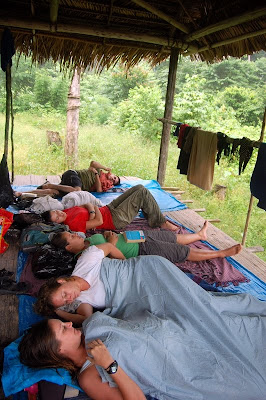
Enjoying a little nap in our wall-less hut

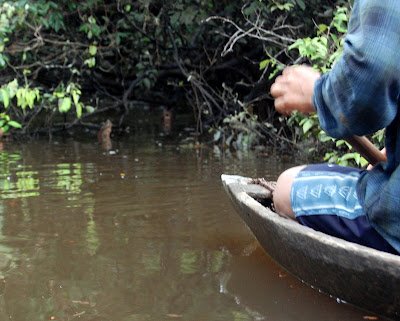
  • This Reserve is famous for being home to pink dolphins, monkeys, anacondas, iguanas, caimans (small crocodiles), piranhas, tarantulas, sloths, tree-dwelling guinea pigs, macaws, river-wolves and more. Thanks to the amazing perception of our guides, our group was able to see all of them in their natural habitat. My favorite animal was hands-down the sloth. They have a definite “so ugly they are cute” quality… kind of like trolls. Our guides found a mama sloth with her baby in a tree and brought them to us to play with. Surprisingly, sloths are not all that difficult to catch. Also, one would think the mama would be upset when we took her baby away from her for awhile. Oh contraire. She was so apathetic about the whole situation that she actually tried to go back to napping within seconds of capture. I love her attitude! On the far end of the “fun animal” scale is the river-wolf, as I discovered after we ran into a pack of them and several swam right under our tiny canoe.


  • Again, our guides truly wanted us to be one with the jungle, and thus took it as their duty to bring us up-close and personal with the animal kingdom. A few examples of us messing with nature:

They spotted an iguana sunning in this tree. Do we leave her alone? Heavens no! Let's try to knock her off and play with her!

Oops, she fell into the water instead...

Playing with piranhas

Catching anacondas with our bare hands


Cudding with Mama Sloth (we do have a lot in common, after all)

And my absolute favorite play-thing, the baby sloth. I want one!

  • Iquitos is a pretty modern city, but it has its fair share of jungle-quirkiness. The highlight for me was the witch-craft section of their market, where you can buy such treasures as fetal-pigs, hallucinogenic herbs, or anacondas in mason-jars. You never know when you might need an anaconda in a jar!


  • We also visited a community in Iquitos called Belen, which is completely submerged in water for 9 months of the year. Thus all of the houses, stores, etc. are literally floating in the river and people get around by canoe. Although my group was wary to get into another canoe, and reasonably so, we had to get into a canoe to see the town during this time of the year. We found a local to take us around, but warned him that if he kept us on that canoe for more than 30 minutes, he would be sacrificing his fee, and possibly even his life. I believe he was a little confused by this, but he delivered on his promise.

The lovely (if slightly smelly) floating town of Belen. Amazingly enough, they have electricity. Seems safe enough, right?


The River is used to travel...

Wash clothes...
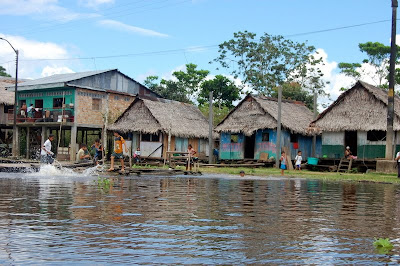
Swim...


Catch delicious fish...


Bathe...

And last but not least... go to the bathroom! (note latrine on the left)

We realized that this area is a bit sketchy after two armed policemen boarded the canoe with us, without saying a word.

  • After the full week it took to travel to Iquitos, I could not get over the fact that it took us 90 minutes to fly all the way back to Lima. 90 minutes: 990 minutes less than we spent on the canoe ride. God Bless you, Wright Brothers.


So there you have it: Kim’s “trip of firsts” in the Amazonian Jungle. I’m glad I did it… but it was undoubtedly my last. Unless you want to come along next time!

Saturday, March 6, 2010

Painting the town red... and blue, and purple, and green, and yellow...

Okay, I believe I left you all hanging a bit with my last blog entry. I just really wanted to let the suspense build before revealing how I finally got revenge against 12 year-old boys across the land. Well, that and I was a little tired of writing at the time. So let me continue on where I left off before I forget all the sordid details… when you last saw Kim, she was soaking wet, running from water balloons and more than a little annoyed with the state of affairs in Cajamarca. All of this changed, however, on the final weekend of celebrations.

Step one was the arrival of my favorite volunteer ladies from the coast… they left their hot and sunny homes to brave Cajamarca’s rainy season and witness the grand finale of Carnival with the rest of us mountain folk. We don’t have much going for us here in the northern highlands of Peru, just beautiful views, delicious cheese and one hell of a Carnival celebration. Through a lucky turn of events, we ended up on the one top-floor room of our hostel, which just happens to open up to a huge porch rising levels above the street and its unsuspecting victims below. Perfect pent-house location for this particular weekend… especially considering it allowed us to launch water balloons and buckets of water while remaining almost completely unseen. It was quite a rush to hit someone, whether it be an individual pedestrian, a pack of kids, or the occasional motorist. The best part of it is: people cannot get mad at you… because it’s part of the fun! There are only two rules to this ingenious game: you cannot hit little old women or people talking on cell phones. Although neither rule is strictly enforced or adhered to. We ended up playing this little game for hours, getting into wars with kids below, other roof-top dwellers and even some fellow Peace Corps Volunteers. The only problems arose when we had to leave for food and beverage runs. Two people would sacrifice themselves to the streets and try to dodge blood-thirsty seekers of revenge and their retaliation balloons. Needless to say, we all got our turn of being soaked. But in the end, I now fully love and appreciate the art of water-balloon-throwing. I suppose I have crossed over to the dark side. But at least I won’t feel quite so disgruntled when those 12 year-old Peruvian boys come at me again next year.

That night we made our way down to the main Plaza in town, which was absolutely brimming with people and music. People were divided up into big groups of varying size, forming hundreds of large circles. Within each circle, the people were playing instruments, dancing and singing coplas. Coplas are short songs of about four or five lines that are sung only in Cajamarca and only during Carnival time. There are hundreds of them, and everybody here seems to know them all. Some of my friends from site taught me the more essential coplas, but I could only remember two. They are mostly silly songs, discussing such subjects as one’s heritage or one’s mother-in-law. So basically they are the equivalent of country music back in the States. A couple of examples of coplas and my rough translations:

“Si quieres bailar, si quieres gozar,
A Cajamarca hay que visitar...
Cuy con papa vas a comer,
la rica chica vas a tomar”

“If you want to dance, if you want to have fun,
To Cajamarca, you must come…
Guinea pig with potatoes you’re going to eat,
A beautiful girl you’re going to take*.

*this is a play on words; “tomar” means both to take and to drink.

“Cuando se muera mi suegra
que lo entierren boca abajo
por si se quiere salir
que se meta más abajo”

When my mother-in-law dies
Make sure they bury her upside-down,
For if she wants to come out
She’ll go further in.


The accompanying dance to these coplas is called, naturally, “Carnival.” It is a lot like the traditional Sierra dance, huaino, but adds some swinging about with your partner. Think a mix between the Shag and two roosters hopping about. Not to toot my own horn, but I have mastered both dances. To be fair, I have had my share of practice here in San Miguel. My friends living in coastal communities had never seen this before and were not too happy when I pulled them into the middle of the circles to dance. Of course, as a large group of gringas, we were quite popular and heavily recruited by just about every circle. It was exhausting, but quite memorable.

As if the balloons and the dancing circles were not enough, the main event for Carnival started up bright and early on that Saturday morning. We awoke to the sounds of drum beats and loud, daunting chants. We all went to the porch to see what the ruckus was about, and saw that it was coming from large gangs of people, donning crazy costumes and painted faces. These gangs were not limiting themselves to water this time… they were also attacking with paint, of all different colors. Just trying to walk the six blocks to breakfast was like racing through a war zone. Passing these tribes of people involved getting pummeled with gobs of paint and buckets of water. Clearly, we were not yet prepared to do battle. But after donning our oldest clothes, sunglasses and hats/head wraps (the paint stings like crazy when it gets in your eyes and getting it out of your hair is a battle in itself), we were ready to enter the streets anew. This time, we would be ready for them. We bought our paint and buckets, filled our squirt guns with the fun-colored dyes, and marched through the streets to our own drum. We sang our verions of the patriotic coplas, including “Proud to Be an American,” and “The National Anthem.” Trust me, reader, the gringo tribe struck fear into the hearts of all we encountered that day. We stopped only long enough to taunt the more aggressive tribes, or dance and sing with the friendlier ones. Even when the rain came pouring down late in the afternoon, an inevitable occurrence this time of year, the streets remained teeming with the mob of multi-colored maniacs. We danced in the streets, soaking wet and looking like loons, but having the time of our lives. So now the fun is packed away. No more water balloons, no more throwing paint. But I have some great memories, a lovely tie-dyed ensemble and the realization that I get to experience it all again next year.
One of the crazy costumes worn in one of the many parades

Another great parade shot


A few tribes terrorizing the streets of Cajamarca


We gringas were not intimidated - here we are on our porch


One of the friendlier tribes
This was after walking six blocks from our hostel to the plaza
Not even vehicles were safe from attack
Taking a quick break to re-charge

Don't you want to come visit next year?

Thursday, February 18, 2010

Running the Risks

I have recently decided, probably against my better judgment, to run a marathon here in Peru. Training for this marathon has been anything but easy. Not that I expected it to be a cinch; I was prepared for the blisters covering my feet, the aching in my legs and even the daily dose of “I just don’t feel like it.” I was not, however, prepared for the unexpected perils that have come along with maintaining a running program in Peru. First of all, I live on top of an Ande. That means 99% of our “roads” (I use that term VERY loosely) require me to run straight downhill, then back up. Better go ahead and pencil me in for a knee surgery Dr. Jorge! Fortunately, I have found two roads that wind around the mountain, and are thus relatively flat. One of the roads is only about three miles long, so I end up having to back-track to get my long runs in. Imagine how puzzling this is for the people I pass along the way… four times.

Problem number two is that I live in a region which blesses us with five straight months of rain. Again, please try to picture the locals watching this weirdo white girl running (for no apparent reason) in the rain, while the rest of the town is desperately seeking shelter. Now when you combine these issues: mountains + rain + dirt roads, you get massive puddles. I have to cross several of them along my routes, and they are getting larger and larger with each passing rainy day. I’m pretty sure some of them are deep enough to drown a donkey. I’ve yet to fall into the abyss, but my pretty white shoes are now indistinguishable from the russet-potato color of those puddles. How appropriate, my entire existence here really does revolve around spuds.

In addition to the terrain matter, I am also dealing with an excess quantity of animal aggression. For some reason, the animal kingdom here in Peru is more troubled by my running antics than my body is. I’ve been keeping a mental tally, and to date I’ve been chased by thirteen campo dogs (campo roughly translates to mean “redneck”), six geese and one inexplicably hostile turkey. I am able to take most of this in stride, but one new menace has threatened to derail my marathon training for good. This pest is of a particularly evil nature and appears to have no natural enemies. What could this thing be, that is multiplying in horrifying numbers? My friends, it is none other than the water balloon. I was hit by the first water balloon in mid-January, and since then I have yet to leave the house for more than three minutes without being hit by another. This tradition revolves around Carnival, which is the celebration leading up to Ash Wednesday. In some places, Carnival is a one-day affair, also known as Mardi Gras. I just happen to have landed in the Carnival capital of Peru… Cajamarca celebrates longer and harder than most places on this planet. I’m not sure how the whole thing got started, but I have a feeling it came from too many bored kids with two months of no school and too much rain. I suppose the theory toward getting wet around here is, “if you can’t beat it… join it.” The result is a full-fledged water war between everyone in town, with no apparent winners and at least one big loser. The balloons and, when people run out of balloons, buckets full of water, come from everywhere: balconies, second-story windows, sometimes even from passing vehicles. So after weeks of running with fear and paranoia, this gringa was ready to get even. My means of retaliation came in the form of 50 other volunteers descending upon the city of Cajamarca last weekend for the climax of Carnival celebrations. Let’s just say I am no longer cursing all inflatable devices, but instead embracing them as my friends. But that’s another story for another day. Stay tuned.

In conclusion, my training schedule has remained intact, and I’m feeling better than ever. Although I’ve never run anywhere close to 26 miles, it is particularly appealing to me at this point in my life. I guess I’m attracted to the seemingly impossible length of distance and time. Trust me, the congruence between marathon training and two years of foreign service is not lost on me. Nor is the struggle to stop focusing so much on the finish line and just enjoy the journey. I’m taking that goal one day at a time, even if that means dodging a few frustrations along the route.


Enjoying a little run in the sun
(please note this picture was taken months ago... the skies haven't been that blue since October)


One of the frienlier beasts I pass along the way
They look sweet and innocent, don't they? Don't be fooled reader! Those black bags are chock full of ammunition
See the yellow one floating in the air?