Wednesday, November 17, 2010

Missed Opportunities

I’ve had a tough run of luck in 2010. This year alone, I have lost, broken or been robbed of three bank cards, two iPods, one passport, four computer chargers, one digital camera, two sets of house keys, one pair of shoes, three cell phones and one laptop.


Granted, I’ve never been accused of being overly careful with my personal possessions, but this seems a little excessive, even for me. I am convinced that all of Peru is conspiring against me… and then laughing heartily as I discover just how difficult it is to replace ANYTHING in this country. It often involves a trip to Lima, double the amount of money it would cost in the U.S., and weeks of waiting (or sometimes months, in the case of a passport or bank card). Don’t even get me started on the paperwork involved. I once tried to exchange a shirt for a different size here, the same exact shirt mind you, and it took me two hours, four store employees and no less than seven signed documents to accomplish my task.

I’m not sure if it’s a mistrust issue, arising from years of dealing with poverty and corruption, but Peruvians absolutely adore official documentation. If you want to meet with the director of the High School, for example, you must first take three copies of a meeting request to his secretary, each stamped and signed, and she will in return stamp and sign all copies, keeping one for the director, one for their files and the final for you. All this just to request a meeting… the actual meeting itself involves lots more paper, stamps and signatures. At first the process left me befuddled, but now I have been converted. I won’t even consider attending a meeting in town unless the proper channels have been executed via my secretary (aka host brother, Jhon). And I’m even on my second pad of stamp ink!


Anyhow, back to the issue at hand: my losses over the course of this year. Although the laptop was arguably the greatest setback (I mean, how else am I expected to watch all those bootlegs DVDs I’ve acquired?), a recent loss has utterly brought me to my knees. Somehow, both of my camera chargers have disappeared. With dead batteries and no way to charge them, my picture-taking has come to a screeching halt. New and hilarious events cross my path daily, yet I have no way of capturing them. Tragic. Absolutely tragic.

To add insult to serious injury, the last two months have been filled with more ridiculousness than I could have ever hoped for. Considering I am literally the only one in town who finds life in San Miguel odd and entertaining, I simply must share these things with outsiders. I realize the effect is not nearly the same without visuals, but in the interest of continuing to blog about this amusing life, I shall do my best to portray what my lenses currently cannot.

Top Things I’ve Wanted to Capture on Film, But Couldn’t:


1. The “New” Ferris-Wheel. While I mentioned in a previous blog that this year’s festival was essentially the same as 2009’s, I overlooked one major detail. This year included one additional joy for the kiddies… a shiny new ferris-wheel! Well, calling it new might be a slight exaggeration. Each seat consisted of two pieces of plywood roughly slapped together with rusty nails. I can only assume it was put together for the World’s Fair Paris, 1889.

Best part… are you ready for this?... the wheel was turned not by a motor, but by two guys grabbing the sides and pulling down in swift motions. I kid you not. The two guys did this for hours on end, night after night. I feel sure this provided more entertainment for me than for the kiddies riding on the archaic disaster-waiting-to-happen. “Sure you don’t want to hop on?” the wheel turners asked me multiple times, as I hovered around like a creep. No thanks… think I’ll stick to the firework towers for now.

2. Trick-or-Treat. If you read my blog from last year, you will know that Peru doesn’t celebrate Halloween, they celebrate Day of the Dead and All-Saints Day. Remember, party in the cemetery, complete with dancing, hot dog vendors and campfires? While this is all well and good, I still missed the traditions from my native land.

So I lectured to a few kids in San Miguel about costumes, going door-to-door and the bags full of candy that we know and love in the U.S. It was early October at that point, so I had forgotten all about it until Halloween day arrived and one of the little boys called me from his mom’s cell phone to schedule a time for his “trick or treat appointment.” Thank heavens I had just received a huge bag of candy from my aunt in the States, or else I would have ended up with some angry kids (I do recall mentioning the “trick” part could involve toilet papering and/or egging someone’s house. Stupid!).

Sure enough two little boys showed up at my door promptly at seven o’clock, dressed in what they thought to be appropriate costumes. One was a “dead zombie skateboarder” and the other was an “army killer with a knife.” They were so earnest and adorable that I ended up giving them half my candy stash.
Word spread like wildfire throughout the town that the gringa was giving out candy, so I ended up with every kid within a 5-mile radius, parading their homespun costumes and demanding their fair share of the loot. It cost me every one of my precious chocolates, but it was worth it to see them indulge in what I would consider to be one of the great American traditions.

3. Traveling in Style. Getting to and fro in rural Peru is always a treat. You literally never know what to expect. Sometimes it’s a good surprise, like when the car gets stopped for an hour as 250 llamas cross the road. Other times, not so good, like when you get stopped for three hours by landslides and impassible roads.

More often than not, however, the surprise comes from how many objects, living and non, can be stuffed into a mid-sized sedan. At current count, my record is eleven people, two large pieces of furniture, five sacks of potatoes and a crate of cuyes. It is certainly not unusual to carry animals along, as their owners will often sell them in the city for a better price. The question of how to carry a live animal is simple: tie it up and strap it to the roof. This is no new thing for me, but my last trip to the capital shook things up a bit.

We picked up a man along the road who was traveling with a rather large goat. He refused to put it on the roof because it was cold outside and he did not want the goat to pick up a sniffle… that could seriously lower his asking price, after all. Peruvians have a hard time saying “no” to anything, so the goat was hog-tied around the ankles and tossed in the back with the luggage. The goat was not pleased with this situation.

I happened to be sitting directly in front of it, so I spent the ride with his head on my shoulder, bleating as loudly as possible into my ear. I couldn’t even get upset, because it was just so funny. You would’ve laughed too, especially if you could’ve seen the picture.


4. Camp. This past weekend I had the pleasure of hanging out with 26 teenage boys, which always makes for some photogenic moments. The event was a leadership camp in Cajamarca run by us Peace Corps volunteers, and we each brought two upstanding kids from our town to participate. The kids participated in leadership activities, toured the local University, spoke with community members in a Professionals Panel and got the chance to interact with other adolescents from around the department. We also threw in some fun, and for many of them, it was the first time travelling to the capital city, first time riding an escalator (there is only one in all of Cajamarca), first time going to the movies and first time swimming in a pool.

While I really enjoyed watching them take interest in college courses, discuss future plans and improve their leadership skills, it was the social aspect that really made me fall in love with these kids. While they were all timid at first, by the end of the first day boys from opposite ends of the department were working together, joking with each other and even walking around arm in arm. It reminded me just how loving the people of Peru can be; they will show their affection toward you in a million ways, even if you were a stranger just the day before. After all, how many American boys (juniors in High School, at that) would put their arm over a male friend’s shoulder as if it were nothing?

Although I don’t have the physical photo, that image will forever remain with me.

5. Sheep-head Soup. It’s not that I’ve never eaten sheep-head soup… trust me, I’ve licked that bowl clean and asked for seconds. But when you witness the process of making it for the first time, it can come as a real shocker. For me, this event happened a few weeks ago when Uncle Tio 2 came to visit (Host Mom’s long-lost older brother who lives in the Jungle, not to be confused with regular Uncle Tio, who lives next door). To celebrate the auspicious occasion, we did what any regular family would do (at least in biblical times): slaughter a sheep. In case you’re wondering, watching a sheep being killed falls right in the middle of the livestock-death scale… worse than watching a cuy go but not nearly as bad as a pig.

The unpleasant part comes when you watch all the pieces coming out and realizing what you’ve been eating over the last year. I’ve learned from experience that ignorance is bliss when you tell yourself everything is breast meat. Those days, unfortunately, have been ripped from me, and I now know exactly what mondongo really is. Although I was generally grossed out by most of this, the fun and photo-worthy part came when we finally ate our sheep-head soup the following day at lunch.

I guess I’ve always just been served a bowl without looking in the pot before, because I assumed the name was just an adorable way of saying that sheep meat was involved. No, no, the title is literal, my friends. Mid-way through our bowls, Uncle Tio 2 opens the pot and proudly pulls out the entire sheep head, then commences to display it as a centerpiece on the table. I thought he was joking as he asked who wanted the eyeball. Turns out Grandma really likes eyeball. The entire family then bartered over ears, lips, tongue, you name it, as the poor little lamb was carved up, Thanksgiving-turkey style.
So for those of you looking to mix up the menu a bit next week, let me know if you’d like the recipe for sheep-head soup!

And Happy Thanksgiving Everyone!

Friday, October 29, 2010

A Brief Reprieve From Donkeys and Drinking-Circles

I know you all tune into this blog mainly to read about my seemingly endless supply of weird food and/or livestock stories, but I must take a short break from my mindless musings to bring you a posting with substance. I know, I know… this is certainly not my strong suit. But let’s give it a whirl, shall we?

As aforementioned, I have been working with a group here in San Miguel that is aimed at helping the disabled population in the surrounding area. When you take a disability and throw in the factors of extreme poverty and a remote location, the problem is exacerbated greatly. There are very few resources here; case in point: San Miguel’s health clinic is equipped with one wheelchair, which, I kid you not, is a plastic lawn chair rigged up with two small wheels on the bottom.

In addition to the physical problems, the handicapped of San Miguel have to deal with the stigmatism of an uneducated population. Many people look at them as freaks and treat them like outcasts.

For these reasons, the civil association “Grupo de Apoyo a Personas con Discapacidad,” or Group for the Advancement of Persons with Disability, was formed. The mission is two-fold: help with the necessary medical treatment and improve the overall quality of life. The group provides money for medicines, operations, etc., as well as offering sensitivity lectures for community members and special events for the disabled.

So where do I come in, you ask? Well, the group has for some time had the dream of building a rehabilitation center here in San Miguel, offering speech therapy, educational courses and more. There is currently no such facility anywhere in the department (department is to Peru as state is to the U.S.). I was asked to help with their organizational development and fundraising campaign. Never in my wildest dreams did I expect to receive full funding for the center during my two years here… but that is exactly what has happened. Through multiple donations, the largest and most recent of which coming from an NGO in Germany, we have now reached our monetary goal. We have also secured a plot of land, donated by San Miguel’s Municipality, and medical/educational services through other local institutions.

The ground-breaking ceremony has already taken place and construction is beginning this week. In order to keep our investors updated with the progress of the construction, we have created a group website (just launched today!). It will be updated frequently with more photos and information… I hope you’ll check it out:


Dreams really do come true!

Tuesday, September 21, 2010

The Parents' Perspective

After managing to survive their trip down south, I invited my parents to write a guest blog about their experiences and impressions. I was a bit nervous about what I would get back, fearing that they would tear my poor host-home to bits. For better or for worse, Peru is my home, my country, my people. And nobody bashes my people but me.

The overall review was not nearly as bad as I expected. I was pleased to read that my parents did appreciate some of the wonders found here, but I guess it takes time to see it all with the rose-colored glasses that I now wear after fifteen months. Sometimes I forget that Peru, in spite of the trash and because of the funny transportation situations, is an acquired taste. I find it perfectly palatable, but others may find it a bit fishy. It was odd to see Peru through fresh eyes, but in the end I enjoyed seeing the perspective. I hope you all do as well:

My husband, Ric, and I were fortunate enough to travel to Peru to visit our Peace Corps Volunteer daughter, Kimberly. I’ve never been to a third world country, so it was quite an eye opener. Kim had warned us that visiting Peru is NOT like a trip to Spain, and she was right in that respect. If you require luxury, I would suggest limiting your visit to Lima – but then you would miss out on some awesome sights. After 24 hours of travelling (actually most of this time was spent sitting in airports), we arrived in the ancient Incan capital of Cusco, gateway to Machu Picchu. We were met at the airport by our guide, German (pronounced Her-mon’), with whom Kimberly thoughtfully charged with our safety. He instructed us on what to do and not to do in this cobblestoned city set at a lofty 12,000 feet above sea level: Take it easy for a day or two, stay hydrated and eat lightly. We heeded his advice and enjoyed strolling the narrow streets, visiting sixteenth century cathedrals and Incan ruins, browsing in shops and watching beautiful dark -eyed children in colorful costumes in the beautiful Plaza de Armas, which in Inca times was the heart of the capital. My personal favorites were the little girls with baby alpacas or llamas who requested that we take our picture with them (for a small fee). Our hotel, Casa de San Blas, was quaint, rustic and very clean.


Mom with her three favorite things: German, an alpaca and a tourist-trap

Two days later we were on our way to Machu Picchu. From Cusco we took a 4 hour train ride and then a 30 minute bus ride to the site. We took the easy route. Kim and her friends hiked for 4 days on the Inca Trail, through rain, hail and snow to reach the summit above Machu Picchu at sunrise. Unfortunately, it was cloudy, so they didn’t actually see the sun come up. They slept in tents at night and were always wet and cold. When we finally met them, they looked so bedraggled! My motherly instincts made me want to give them all a bath and some cocoa. But after a hot meal, they were off and running again, describing the beauty they experienced on the Inca trail. Ric and I had a 2 ½ hour tour of the ruins with a very knowledgeable guide, Pasqual. No picture or documentary can do justice to this site. It truly is one of the wonders of the world. I’m grateful that this was one place the Spaniards did not venture, as they had the habit of tearing down Inca temples and erecting churches. They were not nearly as skilled in the art of building as the Incas, who were truly master builders. I cannot begin to comprehend how they cut blocks of solid granite with such precise angles and used no mortar. Their buildings were virtually earthquake proof, while the Spanish buildings were not. The systems of terraces, aqueducts and fountains, drainage, etc. are amazing. But what makes this place truly remarkable is its setting in the most beautiful mountains and rainforest I have ever seen. It is literally in the clouds. One moment you can’t see anything and then the clouds recede to reveal spectacular views.


The "bedraggled" travelers in need of a bath

Stones of Machu Picchu


Mountainous view behind Machu Picchu city


Post-bath, overlooking city of Cusco

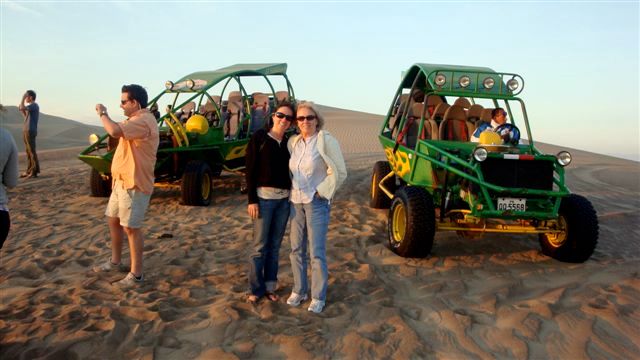
We said goodbye to Cusco and flew back to Lima, a beautiful city with mountains sliding into the Pacific Ocean. It felt great to be back at sea level! We stayed in Miraflores, a lovely section of the city, dotted with parks (one was dedicated to John F. Kennedy), cafes and shops. From Lima, we headed by bus down the coast to the desert town of Huacachina. It is an oasis surrounded by towering sand dunes and is a favorite with young people who love to go sandboarding down the dunes. We all strapped ourselves into dune buggies which raced up and down the dunes, stopping occasionally for Ric and the kids to try out their sandboarding skills. I was the holder of the cameras. The outing ended with a Kodak moment as we watched the sun setting behind the sand dunes.


Miraflores, overlooking the Pacific Ocean


Riding the dunes in Huacachina


Kodak moment


Enjoying a break between buggie-riding


Next we traveled to Pisco where we boarded a boat to visit the Islas Ballestas, or ‘poor man’s Galapagos.’ Along the way, we saw the famous three-pronged Candelabra geoglyph, a giant figure etched into the sandy hills, something like the Nazca Lines. We spent an hour cruising around the islands’ arches and caves, watching sea lions, penguins and thousands of sea birds, such as the Peruvian booby. All too soon, the trip was over, and we were on our way back to Lima.


Sea-lion sunbathing

As we said goodbye to all the Volunteers and their friends, I felt such a sense of gratitude for the dedication and skills these young people exhibited. Peru may have many beautiful and interesting destinations, but it is definitely not for the faint of heart. I found the images of squalor, endless piles of litter and stray dogs quite disturbing. Many Volunteers live without complaining in adobe huts without electricity. They are definitely helping to improve the quality of life for countless people through education, fundraising and better business techniques. I personally will probably not be invited back to Peru because I could not always remember to place the toilet tissue in the trash can, not flush it down the toilet. In fact, I have a feeling the whole country’s sewer system will never be the same!


Tuesday, August 17, 2010

A Propensity for Partying

As I write this blog post, I am finding it difficult to lift my fingers high enough to type. This little gringa is exhausted! Last month San Miguel’s annual festival came blowing through town like a hurricane and nearly took me out in the process. Seventeen days of no work and all play can be seriously strenuous. This marked my second, and last, San Miguel festival, so I was determined to live it up… I also have more friends than I did last year, so they forced me to stick to that vow.

What resulted was a string of nights where we danced til 5 am, then started dancing again at 6 am, breaking only to drink some soup for breakfast. The events were essentially the same as last year (parades, towers of fireworks and marching bands galore), so I’ll spare you the redundancy. What the festival made me realize, however, is that I haven’t fully explained the party process in all of its sordid details. Trust me, after a year of living with this particular family in this particular town, I’ve got it down to a science.

It really is a fascinating thing to behold, in that every celebratory party, whether it is a birthday party, wedding reception or even a funeral, follows the same precise pattern. I know I would be doing you all an injustice if you find yourself in the middle of a Peruvian fete and you didn’t know which way to pass the glass. So here goes, I offer you the instruction manual that I have pieced together during my many months of partying:

1. Do not show up on time. Trust me, I’ve learned this the hard way, showing up to somebody’s house and having the hostess usher me inside to sit by myself for two hours while she washes her hair. Under close study, I have formulated a general guideline. For weddings, show up 30 minutes after the advertised time, one hour for funerals and baptisms, and two hours for a birthday party. The only two events that start on time here are Mass and Bullfights.

2. Once you arrive, greet every person in the room (with a kiss on the cheek for ladies and a hand-shake between men), then sit down, do not talk and stare off into space without making eye contact with anyone. Usually the chairs are arranged in a circle, so it can prove difficult not to catch a stray eye here or there. It takes practice, so do not expect to master it at your first few parties. This first stage of the party usually only lasts for about half an hour, and you’ll know it has ended when the host and his/her minions begin to pass out napkins and plastic utensils.

3. Next comes Meal #1. Typically it involves a questionable piece of meat, rice, potatoes and a vegetable (vegetable = one piece of lettuce). Just a smaller version of your lunch, so nothing exciting there. What makes it fun is trying to cut the mystery meat with a plastic spoon, while balancing the small Styrofoam plate on your lap. Add to that a Dixie cup of Inka Cola and you can just picture the awkwardness that ensues. An important note: don’t forget to bring a few little plastic bags in your pocket for leftovers. Say it’s for your dog.

Every party requires a small staff to prepare the food


The man above demonstrates an excellent balance-your-plate-on-your-lap technique.

4. Speaking of awkwardness, the next phase is without a doubt my favorite. Awkward Speeches!! Beginning with the host and moving around to many of the attendees, each person spends a good five minutes thanking one another for attending or throwing the soiree. The longer your speech, the better. Bonus points if you specifically name and thank 90% of the people in the room. And don’t think that I don’t share in the fun. I have my standard speech, requiring slight tailoring based on the situation that I have given more than a dozen times.

It doesn’t really matter what you say. At Host-Mom’s birthday, I watched as three people who had just roamed in off the street (we always keep the door open on party nights, no matter how cold it gets) and barely knew her gave heart-felt toasts. I really don’t want to Peru-bash and/or stereotype here, but this is a genuine observation that I have made over the last year. Peruvians are really horrible public speakers. And yet they continue, celebration after celebration, to stand up and say their peace. You’ve gotta respect that.

Host-Mom is a master at the speech...

... and so am I, apparently. Check out the applause I garnered!

5. Once the speeches have concluded, everybody gets to down their thimble-sized cup of wine… the sweeter the wine, the better. This serves as a sign that the drinking portion has begun, and those who do not want to partake should go ahead and leave. I’ve never actually seen anybody leave, though. Breast-feeding mothers, five year-old children, Priests, Nuns, the elderly, the disabled. They all stay for at least a round or two (and often many more) of the drinking circle.

The drinking circle is perhaps the thing that most differentiates a Peruvian party from its North American counterpart. The host brings out one bottle (of beer or canazo) and one glass. He pours an appropriate amount into the glass and passes the bottle on to the person at his immediate left – this is VERY important, the bottle must be passed on before drinking. This is his way of saying “Cheers” to everyone. He then drinks the entire contents of the glass as quickly as possible (others are waiting for their turn, after all), occasionally accompanied by a nod of the head and tip of the glass to his neighbor out of politeness and camaraderie. Then, before passing the glass on to his neighbor, he dumps the remaining contents of the glass (foam and/or leftover drops of the beverage) into a communal bowl strategically set in the middle of the drinking circle… or if no bowl is handy, onto the floor. This act serves two functions. First, on a practical level, it clears out the nasty backwash issue that arises when dozens of people are sharing one cup. Second, it symbolically gives a drink to “Pacha Mama,” which is quechua for Mother Earth.

This process continues around and around the circle for the remainder of the night. Simple enough, but a few factors can complicate it. If a man is standing next to a woman, he will often serve her first. If a man is standing next to five women, he’ll go down the line and serve all of them before taking his own turn. Then it can become confusing when dancing begins, as the perfect circle becomes a little discombobulated. But by that point, most are too tipsy to notice or care.

Here's a visual for you:

Lady with the hat passes bottle to boy on her left (let's just ignore the fact that he is clearly not drinking age, shall we?)

Boy pours himself a little...
After passing the bottle along, he drinks...
After dumping contents on the floor, he passes along the cup. Continue ad nauseum.

6. Although the music comes on as soon as the speeches wrap up, dancing does not begin until the drinking circle has gone around a few times. They may be Latin in more ways than one, and the opposite of timid when it comes to asking personal questions and professing their love for you, but Peruvians can be shy to dance until they have the proper incentive.

Enjoy this time, though, because once the dancing begins, do not expect to get much of a rest for another six hours or so. Everybody seems to agree at the same time that it is time to dance, but women have to wait for a man to ask her to dance. You don’t really see groups of girls dancing together, as in the United States. No, no, it must be a one-guy-to-one-girl affair. Also it is considered rude for a woman to turn down a dance request from any man. It reminds me of a 1950’s High School dance, except for the booze, of course.
7. As aforementioned, dancing ensues and dominates the scene for the remainder of the party. It is only interrupted for a series of small meals, depending on how long the party goes on. Meal #2 is usually (in San Miguel, at least) a cup of pre-sweetened coffee and a small plate piled high with cheese, bread and cake. Note: here is another great opportunity to use those little baggies you brought along. This cake is not to be confused with the “Fill-in-the-event Cake,” which will come out later. When the official cake is served, you usually have another round of speeches and shots of sweet-wine. These speeches, I’m sure you can imagine, are a lot more fun to witness.
They seem to be really enjoying their cake and jello, right?
8. Drinking continues and dancing gets more intense. You often find whoever is controlling the stereo will begin playing the same three or four songs over and over again… the real crowd-pleasers. At this point (most) guests with small children begin to filter out first, followed by older people and people who can’t dance (unless they’re directly related to the host). Then there’s a three hour gap where nobody leaves. This is the real party time. Usually the host will fish out a few old Coke bottles filled with unidentifiable liquor and add them into the drinking circle. Several beer runs inevitably take place. LOTS of posed photographs are requested and taken. As a rule of thumb, the party doesn’t die until: A.) The alcohol (and money to buy more alcohol) runs out, or B.) The sun comes up. I’ve seen plenty of both endings.
Posed-Photo time!
Often you think the party is about to end... then somebody rolls in last minute to save the day.
5:30 a.m. and the party is still rolling on!
So there you have it, in a nutshell. I’ve come to really enjoy the Peruvian party and its quirky nuances. Nothing has taught me more about the culture of this community and how greatly they esteem communal bonds, created through sharing a meal, a dance and a cup.
A few more visuals for you:
No bottle-opener? No problem! I've learned to open a bottle using the lid of another bottle.
(I'm currently at 65% accuracy, but hoping to have it down pat before returning to the States.)
I'm also learning how to open a wine bottle by slamming it against the wall. Seriously.

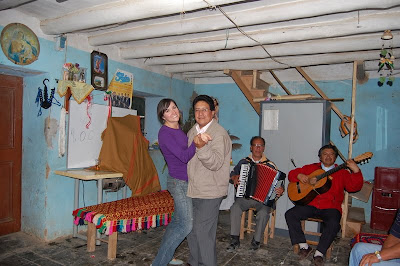
Sometimes Host-Mom and I break tradition and dance together.
Don't forget that babies like to party too!

From Peru to You... CHEERS!

Monday, August 2, 2010

Down and Out Down Here

I have just completed a true rite of passage for Peace Corps Volunteers, which is the inevitable period of drawn-out and dilapidating illness. Most, at least in Peru, deal with stomach issues for months without end. I have had my minor issues here and there (the word “minor” changes drastically between first-world and third-world countries), but I have fortunately avoided the diarrhea-fate of many of my friends thus far. Instead, I paid my dues in the form of a minor cold, which escalated to a flu and then bronchitis. If you knew me in the U.S., then you know that I am NEVER sick. On the incredibly rare occasion when it did occur once a decade or so, you also know that it would pass in a matter of days and I generally wanted to be left alone. I don’t like to be babied; I just like to sleep it off in peace and quiet… sort of like a dog will just disappear when it is ill and reappear a few days later as if nothing had happened. No muss, no fuss. I guess I expected things to be exactly the same for this little cold when it developed, but boy was I wrong, as I have been about so many things here in Peru. This episode went on for weeks, and I am just now coming out of the dark tunnel onto the other side. And although I was able to spend a few relaxing weeks in Lima by myself, my time in San Miguel was far from peaceful. I should have expected the outpouring of pestering, considering how darn nosy the people of my lovely town are known to be. What I call “nosy,” they consider being concerned about the general welfare of every individual. It is their duty then, to care for those in need, especially the only outsider living within their ranks. And judging by the fact that I did crazy things like drink cold water (the number one cause for disease and number two cause for death, just after “catching some bad air,” in San Miguel) and prance around town in just one pair of pants (not even fleece pants for the love of Pete!!), I was clearly not competent enough to handle myself, in sickness or in health. So Host-Mom took control of my get-well regimen at home, and I could barely make it out the front door before helpful advice came flying at me from every well-intentioned direction. The experience showed me just how superstitious the people of Peru remain, especially those in the rural Andean region where I live. Just as the Haitians created and still cling to Voodoo practices, superstitions arise and survive more prominently in regions that suffer from poverty and/or lack of proper medical care. Once I remembered this, I was able to take the advice in stride, without wanting to pull out too much of my hair. The poor and uneducated have to blame illness on something, and there has to be an equal cure available in some form. To illustrate, here are a few examples of beliefs that are still widely believed here in Peru:

As I’ve already mentioned, The Bad Air is a well-known and widely-feared cause for illness and even death in rural areas. The Bad Air can be caught any time and anyhow, and I have found that it is typically blamed for just about everything when people do not know the real cause or when the real cause is too scandalous to imagine. I’ve heard stories of a man who was hit by a car and when he died, it was blamed on catching the Bad Air just before being hit by a car.

The Evil Eye: This is a big one, and I know that many cultures around the world have something similar. The Evil Eye is transferred from another person, often unintentionally, who is jealous of you or dislikes you for an unmerited reason. You can go years with an evil upon you, and it brings you bad luck and possibly even illness. To diagnose, somebody (preferably a reputable shaman… naturally) will hold an uncooked egg an inch or two above you and move it along the entire perimeter of your body. It is then cracked in a glass, and if a round “eye” separates from the yoke and rises to the top of the glass, then you my friend have been given the Evil Eye. In that case, you must flush the egg down the toilet without looking at it. Just like that, problem solved! I actually had this little ritual performed on me last year during training, after accidentally volunteering myself to my language professor, who just so happens to moonlight in shamanism from time to time. I was told I did have it, and I flushed her down as told… but I’m seeking a second opinion once I find a shaman who is backed by the American Medical Association. As if this wasn’t weird enough, just guess how this custom is varied here in the mountains. That’s right, instead of an egg, they use a live cuy. Of course they do! I couldn’t make this stuff up if I tried.

Two friends who live in on the coast relayed to me that there is a belief that any sickness can be cured by grabbing chunks of a person’s hair and yanking it as hard as possible until you hear a popping noise. This act is repeated all over the head, and my friends casually mentioned that their host families had performed this act on them several times. I think I’ll take the mountains and our hovering guinea pigs.

With all of these colorful diagnosis and treatment options, I was somewhat surprised by host family’s ultimate conclusion. They ran the numbers and determined that I was sick, simply enough, because I am too skinny. The cure for this dreaded disease was also a straightforward one: more potatoes. That, and I really really have to stop drinking cold water.

So, sorry for the lack of pictures in this blog. I did quite a bit of google-searching for a picture of a shaman or any one of these treatment options, but I came up empty. Guess Peru’s medical practices are not widely known. Well now the three of you know… lucky bunch!


Saturday, June 19, 2010

Land of the Free and Home of the Seven-Layer Burrito

I must apologize to those 2 or 3 of you who regularly keep up with my blog, as Cuy For Me has been out of commission for quite awhile. Sorry folks, but this has been quite a month for me. First of all, I went to visit THE UNITED STATES OF AMERICA. It was weird… but wonderful. I’ll get to that in a bit. Anyhow, upon my return, I celebrated two major milestones within one week. The former arrived on June 6th, and it marked one-year of living in Peru. The latter, a much more common occurrence, was June 9th, and it was my birthday. It is only notable because it was the second birthday I have spent here in Peru. The first came around (obviously) within my first few days of arrival to the country last year. It was surrounded by a haze of confusion and apprehension. Just days before, I had been thrown into a group of total strangers, shipped off to a foreign country, and poked and prodded with every injection known to man. This year could not have been more different. I am now comfortably settled into this country… I have friends, family, co-workers and students, all of whom could not WAIT to celebrate my birthday. Peruvians just love to celebrate birthdays – shocker! Upon meeting a new Peruvian, the question, “When is your birthday?” will undoubtedly occur within the first five minutes of conversation, just between “Are you married?” and “How much do you weigh?” They also seem to harbor some internal clock which automatically banks all of this information. You may try to tiptoe around the whole birthday thing, hoping that maybe people have forgotten, but no such luck.


My cake was so pretty that I didn't even mind the misspelling on my name!


The big day will arrive and out of nowhere the entire town descends upon you with birthday wishes, parties and (best of all) lots of food! Now this all sounds well and good, so why would anyone try to hide from it? The answer is a four-word phrase that has been daunting me for months: torta en la cara. This means ‘cake in the face,’ and describes the custom for birthday celebrations in my town. The lucky lad or lassie has to “taste” the cake before eating, and is inevitably shoved so that the cake is smeared all over his/her face. There have also been cited incidents where extra icing is requested from town-cake-lady and comes flying in from all directions, landing on your clothes, in your hair and in just about every other uncovered flesh. No hot water and 30 degree temperatures make night-time bathing impossible, so add “sleeping in icing” to the element of fun.


Despite the eight-month build-up, my torta en la cara celebration was actually not that bad. In fact, it was pretty fun. I turned the tables on my friends and spread the cake on them. It resulted in quite the evening, and it is definitely going to remain high on my list of memorable birthdays. So I must give a great big “thank you” to all of San Miguel, for without this loving little town, birthdays, and Peru in general, would not be nearly as enjoyable.


Now, reaching these milestones brought about the need for reflection; people in their “late 20’s” have a tendency to do this, or so I hear. Not only have I officially spent one year in Peru, but I am still processing my recent trip to the U.S. How do I even begin to describe my beloved country? It’s chock full of so many things: big people, big cars and even bigger food portions. But if I had to sum it all up in a word, it would be ‘freedom.’ It may be cliché, but this is without a doubt the one word I would use to describe the United States of America. Not that I am necessarily an expert on this subject anymore, but my recent visit home afforded me quite the fresh perspective. It was just a hair shy of one year without seeing my homeland when this little gringa arrived on U.S. soil. Overwhelmed with feelings of nostalgia and fatigue, I sobbed my way through the customs and baggage-claim process. It was so strange to hear English being spoken everywhere, to pay with American bills and to realize that not every single person was starting at my whiteness. Leaving the airport was when the real fun began. I was reminded just how easy everything is: hop into your own car, drive out on paved roads and go wherever you want. There is no waiting hours for 7-8 other paying passengers, no strangers sitting on top of you with their breast-feeding babies or sacks of cuy and (most amazingly!) no hopping out of the car to help push it through especially muddy parts of the road. While taking in the ease of transportation, I was also reminded of the vast food choices that exist out there in the real world… and just how easy it is to access them. My eyes bulged and my stomach growled as we passed convenient stores, drive-thru joints and ethnic restaurants galore. Taco Bell, Arby’s and Bojangles… oh my! And I’m not even going to START on the joys that are Publix and Costco. It was not until I lived without such luxuries that I truly came to appreciate them. I try to picture what life might be like in San Miguel if everybody had a car. I cannot imagine such a sight, as they really wouldn’t have anywhere to go. It’s a 3+ hour trek to the city, and there are no shopping malls, restaurants or grocery stores between here and there. In a way, however, it is kind of nice. Any place you need to go, anything you need to buy, any person you want to see is within a 5-minute walk. Granted we don’t have Big Macs or 1,000-count boxes of Splenda, but we have a stronger sense of community than anywhere I have ever seen… not to mention some really great party traditions. So although it was hard to board that return flight in Hartsfield-Jackson and say goodbye to all the freedom and delights of America, including that one last bagel with flavored cream-cheese that I scarfed down all the way through the jetway, I know that Peru has her own special treats in store for me.


Just one more year to take it all in!


Thursday, April 22, 2010

Jungle Fever

They say there is a first for everything, and I have experienced my fair share of “firsts” this month. Just a few of these include handling a live anaconda, going for a night-time crocodile hunt and boating up the Amazon River in a canoe. The last on this list ended up being the worst, albeit most memorable, experience of my life. But I’ll get to that in a bit. Let’s begin from the beginning, shall we? For those of you not living in Peru, it might have slipped past you that the first week of April was Semana Santa, or Holy Week to my non-Spanish-speaking friends. The Peace Corps was gracious enough to give us hard-working Volunteers a few days off, so we took advantage of the rare opportunity and ventured out to see the Peruvian jungle. Here’s an interesting statistic taken directly from my Lonely Planet for your educational pleasure: roughly 50% of this country is covered by jungle, yet only about 5% of its population lives there. After this trip, I’m surprised it can manage to hold onto such a high percentage. Don’t get me wrong, it was everything I imagined and more… it’s just that jungle life is intense. Getting around this region makes transportation in the rest of the country look more efficient than a German train system. Example of a "taxi" we took numerous times... and got stuck in the mud several times:


I guess it doesn’t help that we chose the city of Iquitos for our final destination on this trip. Iquitos is famous for being the largest city in the world that you cannot reach by land. The result was a whole lotta boat travel. Our planned itinerary went something like this:

  • Bus from sites to meeting point in the city of Chiclayo (5.5 hours for me)
  • Bus from Chiclayo to city of Tarapoto (16 hours, over ROUGH terrain: several moments I found myself airborne)
  • Car from Tarapoto to town of Yurimaguas (3 hours, lots of hairpin curves)
  • Boat from Yurimaguas to town of Lagunas (10 hours)
  • Three-day canoe trip from Lagunas through a natural preserve, returning to Lagunas
  • Boat from Lagunas to Iquitos (32 hours)
  • Fly from Iquitos to Lima (1.5 hours… this was hard to believe after the week it took to actually arrive in Iquitos)
  • Bus from Lima to sites (16 hours for me)

Sounds like a good chunk of travel, no? Well, just hold on to your britches, because it gets better. The 32-hour boat ride to Iquitos was supposed to be on a large vessel, where we could hang up our hammocks, walk around, use the bathroom, etc. Not too bad. Unfortunately for us, this particular boat couldn’t leave due to “excess rains.” Apparently the mighty Amazon River couldn’t handle a little excess water. Seriously. So we were all stuck in the town of Lagunas an extra night, which was one night too many. The only decent hostel in town was full, so we ended up in the most horrid place I have ever seen. Trust me, that is saying a lot for a Peace Corps Volunteer and former backpacker. After being eaten alive by mosquitoes and other less-expected creatures in our room, we awoke to the news that the boat would not be leaving again the following day. It is difficult for me to explain how little the town of Lagunas has to offer, but let me just say that the extent of its “entertainment” that we found was eating canned-cheese and stale crackers in a hardware store. I could just envision myself being stuck in that remote and insignificant jungle town, being adopted by natives and eating grubs for the rest of my life. Any alternative was better than spending another night there. Alas, the list of alternatives was limited to one option: we could hire a couple of locals to take us in a smaller boat. It would cost us some serious soles, but it would only take 8 hours. Or so they said. When we arrived at the dock, we saw a small boat that seemed barely large enough to contain all of us (14 Volunteers in total and 3 locals). There was no bathroom. They didn’t answer when we asked if we could hang up all of our hammocks on this boat. In hind-site, this question must have seemed rather hilarious to our local drivers. We could not understand why they chuckled until a canoe, roughly 1/10 the size of that boat pulled up. Each of us watched incredulously as the men took the motor off of the small boat and attached it to the back of the much-smaller canoe. Clearly they don’t plan on piling all of us in that thing for eight hours, right? Oh Peru, you never fail to shock me.

Lovely town of Lagunas... it was hard to leave her behind!

The boat we thought we'd be taking... and the tiny canoe to the right of it

As the town of Lagunas waved from the shore, our little troupe of 17 took off to tackle the vast Amazon… in our canoe. All was going well until about the 5-hour mark. Somebody asked the driver how much further we had to go. The response was, “in an hour, we will be 8 hours away.” Excuse me? I thought we were 8 hours away 5 hours ago?? Yes, there was a “slight miscalculation.” Well there’s an understatement for you. So this meant that our 8 miserable hours on the canoe would turn into 14 miserable hours. We might have actually reached that goal, if not for the fact that our driver got lost somewhere in the middle of nowhere for about 4 hours. You do the math. 18 hours, 17 people, 1 canoe. Now add to the equation heavy rain with only a mildewed tarp for protection, a temperature drop of 30 degrees from day to night (and no way get to any extra clothes in our bags) and no padding between the hard planks and our battered bodies. Tons-o-fun! Needless to say, we all reached our breaking points… several times over. Each time I thought I had reached the depths of misery, a new factor would be presented to make me yearn for the comforts I had previously enjoyed. For example, I complained of the blistering heat during hours 1-4. Oh how I longed for some warmth just a few hours later as I sat in soaking wet clothing and spooning with Steph under a dirty hammock for the body heat. We finally arrived in Iquitos just after dawn, more than a little worse for the wear. The expression, “rode hard and put up wet” comes to mind every time I picture us clambering out of that canoe and stretching our legs to full capacity for the first time in an eternity. Beginning to understand why I called it miserable but memorable? I do have to say, we made some memories.

All 17 of us snuggled into our mighty canoe

Here we are at dusk, approximately 5 hours in... still smiling! But that was before the bad news hit

Truth be told, the rest of the trip more than made up for that little bubble of gloom. Because I spent so much time and energy describing the canoe trip, I’ll have to resort to bullet points to highlight the rest of our trip.

  • The town of Tarapoto, called the “eyebrow of the jungle,” was quite lovely with its mix between tropical jungle and mountainous terrain. We went to see a huge waterfall and were able to jump from behind the waterfall into a pool below. The water was freezing, but totally worth it for the photo-ops:

  • On the boat-ride to Lagunas, everybody brings a hammock and hangs it in the boat. The result is a crazy maze of ropes and bodies, and is truly an experience. Nothing beats relaxing in a hammock and staring out over the Amazon River, as an endless line of tropical trees and thatched-roof villages passes by. The best part about this leg of the trip was its authenticity. The locals in this region really do travel in this mode; it is certainly not put on just to entertain tourists. In fact, we were the only “tourists” on the boat. Even the live chickens in the kitchen had their purpose for being there:

  • The 3-day canoe trip through the Pacaya-Samiria Nature Reserve was a paramount experience that I will not soon forget. It was just our group of Peace Corps Volunteers, our local guides and the jungle… no other signs of life, except for the millions of animal eyes watching us as we glided up the river. We slept outside (with nothing but mosquito nets and a thin sheet for protection), ate what our guides cooked for us over open flames and got to hold wildlife that I had never even seen before.

Moment of embarkation with our fabulous guides, Felix and Arri

Felix could always get us out of a tight spot


I got to look at these lovely heads for many an hour!


Even a little (or a lot of) rain didn't dampen our spirits at that point

Night-time crocodile hunting: why not?

Problem: How does one use the bathroom when on a canoe?

Solution: Felix takes you off in the canoe alone and turns around as you squat off of a log.

Our guides cooked all of our meals for us (seen above washing the veggies in river water)

But don't forget the main course!

Night 1 Sleeping quarters: this was before we had a hatred for hard planks

Night 2 Sleeping Quarters was the lap of luxury compared to the night before!

Bath time!

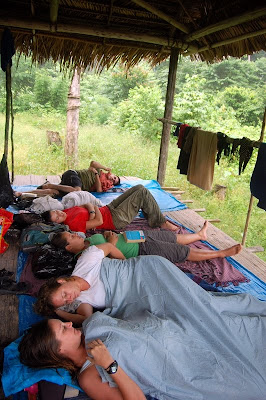
Enjoying a little nap in our wall-less hut

  • This Reserve is famous for being home to pink dolphins, monkeys, anacondas, iguanas, caimans (small crocodiles), piranhas, tarantulas, sloths, tree-dwelling guinea pigs, macaws, river-wolves and more. Thanks to the amazing perception of our guides, our group was able to see all of them in their natural habitat. My favorite animal was hands-down the sloth. They have a definite “so ugly they are cute” quality… kind of like trolls. Our guides found a mama sloth with her baby in a tree and brought them to us to play with. Surprisingly, sloths are not all that difficult to catch. Also, one would think the mama would be upset when we took her baby away from her for awhile. Oh contraire. She was so apathetic about the whole situation that she actually tried to go back to napping within seconds of capture. I love her attitude! On the far end of the “fun animal” scale is the river-wolf, as I discovered after we ran into a pack of them and several swam right under our tiny canoe.


  • Again, our guides truly wanted us to be one with the jungle, and thus took it as their duty to bring us up-close and personal with the animal kingdom. A few examples of us messing with nature:

They spotted an iguana sunning in this tree. Do we leave her alone? Heavens no! Let's try to knock her off and play with her!

Oops, she fell into the water instead...

Playing with piranhas

Catching anacondas with our bare hands


Cudding with Mama Sloth (we do have a lot in common, after all)

And my absolute favorite play-thing, the baby sloth. I want one!

  • Iquitos is a pretty modern city, but it has its fair share of jungle-quirkiness. The highlight for me was the witch-craft section of their market, where you can buy such treasures as fetal-pigs, hallucinogenic herbs, or anacondas in mason-jars. You never know when you might need an anaconda in a jar!


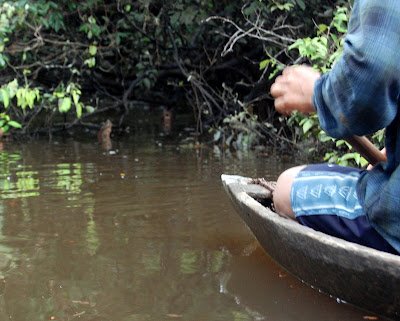
  • We also visited a community in Iquitos called Belen, which is completely submerged in water for 9 months of the year. Thus all of the houses, stores, etc. are literally floating in the river and people get around by canoe. Although my group was wary to get into another canoe, and reasonably so, we had to get into a canoe to see the town during this time of the year. We found a local to take us around, but warned him that if he kept us on that canoe for more than 30 minutes, he would be sacrificing his fee, and possibly even his life. I believe he was a little confused by this, but he delivered on his promise.

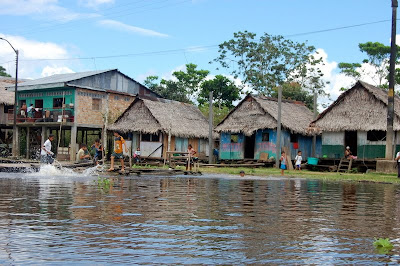
The lovely (if slightly smelly) floating town of Belen. Amazingly enough, they have electricity. Seems safe enough, right?


The River is used to travel...

Wash clothes...

Swim...


Catch delicious fish...


Bathe...

And last but not least... go to the bathroom! (note latrine on the left)

We realized that this area is a bit sketchy after two armed policemen boarded the canoe with us, without saying a word.

  • After the full week it took to travel to Iquitos, I could not get over the fact that it took us 90 minutes to fly all the way back to Lima. 90 minutes: 990 minutes less than we spent on the canoe ride. God Bless you, Wright Brothers.


So there you have it: Kim’s “trip of firsts” in the Amazonian Jungle. I’m glad I did it… but it was undoubtedly my last. Unless you want to come along next time!